

|
💶
€26B Total budget |
✈️
10M Mobility GOAL |
📅
7 years Programme cycle |
⚠️ Important note on Erasmus Accreditation
Erasmus Accreditation automatically expires at the end of the current Erasmus+ programme period. The last call for accredited organizations will be in February 2027, and any KA1 funds awarded must be fully used by May 2029. To remain accredited afterwards, organizations will need to reapply under the new Erasmus+ Programme (2028–2034) — likely through a simplified procedure.
The Erasmus+ Programme
In this article, you will find an updated overview of the Erasmus+ programme and the opportunities available for schools and teachers.
If you are thinking about organising a mobility project, now is the right time to start planning.
🔗 And if you need support with your Erasmus+ project, Europass Teacher Academy is here to help you at every step!
🎓 What Is Erasmus+ and Why Is It Important for Schools?
Erasmus+ is the European Union programme that promotes internationalisation, innovation and the modernisation of education.
For schools and teachers, it offers the opportunity to attend training courses abroad, discover new teaching approaches, develop innovative tools and collaborate with colleagues from other countries.
Thanks to Erasmus+, many schools have launched exchange projects, built international networks and strengthened their European dimension. For many teachers, the programme has also been a valuable chance to gain international experience and bring fresh ideas back to their schools.

📅 Erasmus+ 2021-2027: Priorities, Funding and Mobility
Every year, usually in November, the European Commission publishes the new Erasmus+ guide, including deadlines and instructions for project applications. On a broader level, the programme is updated every seven years with new priorities and a new budget.
🔗 Check our Erasmus+ funding deadlines to stay up-to-date!
For the 2021-2027 period, Erasmus+ aims to fund 10 million mobility projects and involve a wider range of educational institutions, from higher education and vocational training to primary schools, secondary schools, pre-schools and kindergartens. Inclusion is one of the programme’s main priorities, with specific funding available to support participants with fewer opportunities or additional needs.
Erasmus+ also encourages schools to develop a long-term international strategy, take part in European projects on a continuous basis and build lasting partnerships with other organisations.
Moreover, schools can also organize blended mobility through a range of activities, which makes these projects more flexible, attractive and engaging.
The Structure of Erasmus+
The Erasmus+ programme is organised into four main actions for the education sectors: Key Action 1 (KA1), Key Action 2 (KA2), Key Action 3 (KA3) and Jean Monnet Actions.
|
✈️
KA1 Individual Mobility |
🤝
KA2 Cooperation Partnerships |
🏛️
KA3 Policy Reform |
📚
Jean Monnet EU Studies |
For schools and teachers, the most relevant opportunities are usually KA1, which supports mobility projects for teachers, school staff and students, and KA2, which funds cooperation partnerships between schools and organisations across Europe.
KA3 focuses mainly on policy reform and larger-scale initiatives, while Jean Monnet Actions promote teaching and research on the European Union.
The main difference between KA1 and KA2 is that any school can apply for KA1 funding, even without an international partner at the application stage. KA2 projects, on the other hand, require schools and organisations to form an international partnership before applying.
Let’s look at the main opportunities in more detail.
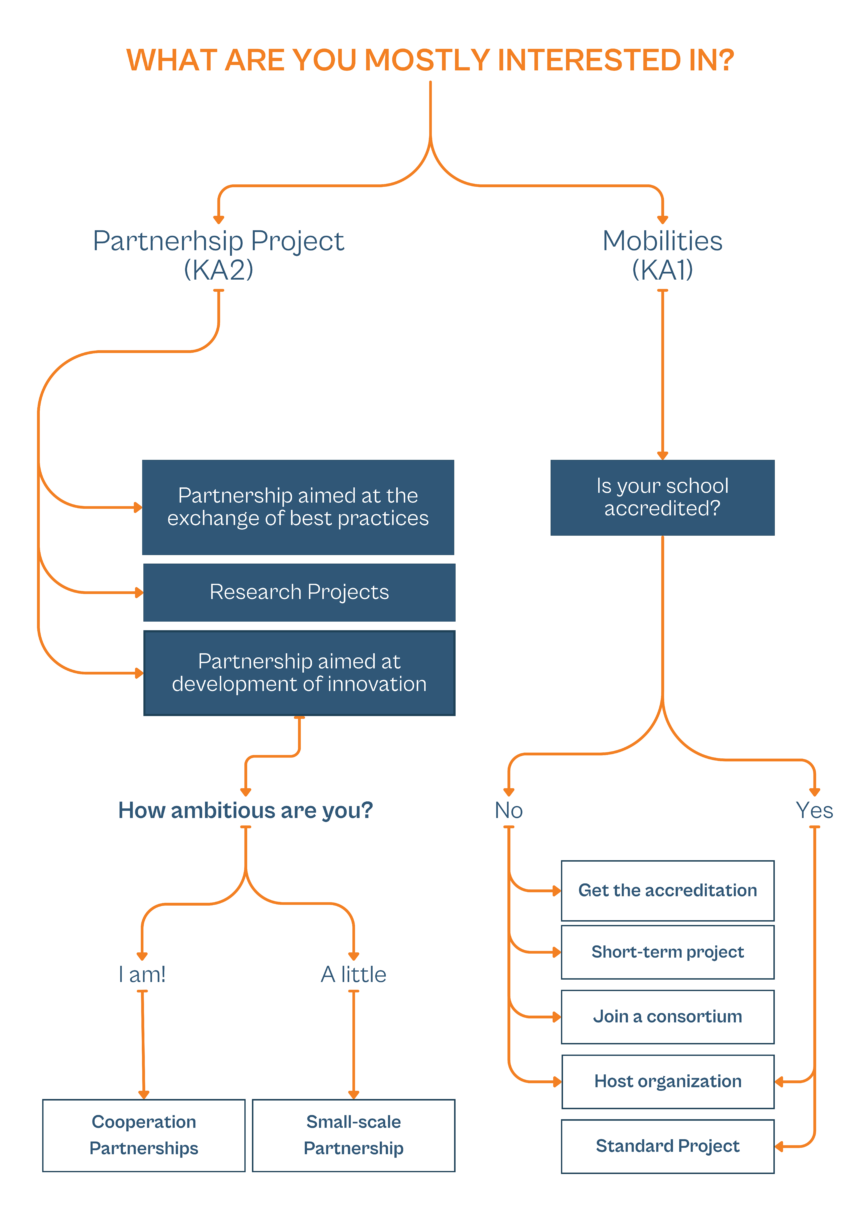
✈️ Key Action 1 – Individual Mobility
Key Action 1 supports mobility projects for individual schools or organisations. Schools can also create a consortium to share the efforts of managing a project and creating new synergies.
Any new organization can enter a consortium at any given time. So, if your school has missed the deadline to apply for funding, you can still participate in the project by joining a national consortium whose proposal has already been approved.
Through KA1, teachers, school staff and students can travel abroad for different types of learning experiences:
🎓 Professional training for teachers and school staff. These projects allow teachers and school staff to attend face-to-face professional development courses abroad, gain new skills and exchange ideas with colleagues from across Europe.
🔁 Sharing good teaching practices. Teachers can travel abroad to teach in another school, support local teachers in their daily work or take part in job shadowing experiences. These opportunities are especially useful for language teachers and educators at the beginning of their careers.
🎒 Student mobility. KA1 also allows groups of students to travel across Europe and visit foreign schools. Thanks to Erasmus Accreditation, schools can plan these exchanges regularly over several years, without needing to apply through a KA2 partnership.
However, it is not easy to organize students’ mobility without a partner institution abroad, which is why we decided to offer students our high-level workshops through the Europass Student Academy.
🤝 Key Action 2 – Cooperation Partnerships
Key Action 2 funds cooperation partnerships between schools and organisations from different countries. Unlike KA1, these projects require an international network before the application is submitted.
These actions have 3 objectives:
🌍 Cooperation and exchange of good practices. Schools can create international networks, take part in project meetings and share effective approaches to common educational topics or challenges.
💡 Innovation. KA2 partnerships are designed to create new educational tools and resources, such as teaching activities, guidelines for teachers, assessment tools, digital platforms or learning systems.
🔬 Research projects. These partnerships can also involve universities and higher education institutions to develop research-based educational projects.

🏛️ Key Action 3 – Support for Policy Reform
Key Action 3 focuses on policy reform and large-scale European initiatives. These projects usually involve significant funding and are managed directly at European level, often by the European Education and Culture Executive Agency (EACEA).
For this reason, KA3 is generally less relevant for individual schools and educational institutions looking for mobility or partnership opportunities.
📚 Jean Monnet Actions
Jean Monnet Actions promote excellence in teaching, learning and research on the European Union, focusing on European integration, EU values, history, institutions, cultural diversity and active citizenship. Traditionally aimed at higher education, since 2021 they’ve also opened up opportunities for schools and VET providers.
Schools can take part in several initiatives to improve and share teaching practices on EU-related topics, collaborating with teachers from other Programme countries, exchanging methodologies, organising co-teaching, and developing supporting materials.
One key opportunity is the Learning EU Initiative, which supports introducing EU-related topics (values, history, how the EU works, cultural diversity) into the school curriculum. Projects run for three years, with at least 40 hours of EU-focused activities required each year. Each school can receive up to €35,000.
Schools and VET providers can also join Jean Monnet Networks in other fields of education and training, consortia that exchange good practices and organise co-teaching experiences across countries (up to €300,000 per project), and benefit from Jean Monnet Teacher Training, delivered by higher education institutions or teacher-training bodies to help school and VET staff build the confidence and skills to bring EU content into their classrooms (up to €300,000 per project).
Higher education institutions have further dedicated strands not open to schools — Jean Monnet Modules, Chairs and Centres of Excellence for teaching and research on the EU, and thematic Networks under the Jean Monnet Policy Debate strand.
Jean Monnet Actions are centrally managed by the EACEA (European Education and Culture Executive Agency), and applications are submitted through the Funding and Tenders Portal.
Erasmus Accreditation
Erasmus Accreditation is like a ‘loyalty card’, similar to those distributed by large chain shops or supermarkets, but in this case, it is specifically for schools of all types and levels.
A school needs to receive the accreditation only once every seven-year programme. This is sufficient to make it recognized by the National Agency as an organization that deals with international mobility on a regular basis. Hence, the school that receives the Accreditation does not need to apply again for it within the 2021-2027 Programme.
To apply, educational institutions must outline their own strategy for medium- and long-term internationalization and modernization by presenting an internationalization strategy and an Erasmus+ Plan. They must also commit to meeting Erasmus+ quality standards, which specify how the school will organize the international activity.
Receiving the Erasmus accreditation has many advantages:
💵 Stable source of funding for the whole duration of the Programme.
📋 Simplified application procedures in response to Erasmus+ calls.
⚡ Quicker evaluation process.
🎓 Erasmus+ Programme for non-accredited organizations
The deadline for the Erasmus accreditation usually expires in October. However, if you missed the deadline, don’t worry — your school still has many opportunities to participate in the Erasmus Programme.
🎯 Short-term projects. Key Action 1 includes specific projects dedicated to non-accredited organizations. They allow a smaller number of participants to take part in shorter international mobility, with a simpler application process — a perfect entry point for schools with no prior similar experience.
🌍 Join an accredited consortium. Your school can join a national consortium whose proposal has already been approved, even after the deadline.
🏡 Act as a hosting organisation. Your school can welcome teachers or staff from another accredited foreign school, participating in Erasmus+ without applying directly.
🔔 Don’t forget that the call for accreditation reopens every year!

How to Participate in the Erasmus+ Programme
If you’ve made it this far, you have already discovered many of the opportunities offered by the Erasmus+ Programme.
🔗 If you are interested in applying for an accreditation project, a good starting point is our free self-paced online course, The Erasmus+ Programme Made Easy, which explains step by step how to prepare an effective accreditation proposal with a higher chance of being funded.
If you missed the accreditation deadline, or you if it’s your first Erasmus experience and you want to go for the easiest option as, you can follow the step-by-step instructions below on how to apply for a short-term project (KA122).
Before the Mobility
🗓️ Check the Eligibility Criteria and the Deadline
Recommended timing: 14 months before
Make sure your organisation is eligible to apply for funding in the chosen sector, read the Erasmus+ Guide carefully and check your National Agency‘s website for updated information: current calls, rules and priorities can shift from year to year.
Planning should start around 12 months before your first mobility. Even before the call opens (check the deadlines), you can start preparing the mandatory documents to get your Organisation Identification number (OID).
🎯 Link Your Project to Your School’s Real Needs
Recommended timing: 12 months before
A strong Erasmus+ application is clearly connected to the current needs of the school or organisation applying. European funding increasingly supports whole-school projects that contribute to long-term development, so even if you apply for a short-term project, your proposal should rest on a clear analysis of your institution’s needs and goals.
Bring together a small working group (head of school, coordinator, 2-3 teachers) to do this needs analysis honestly – ask “what problem are these activities actually meant to solve?”. This is also when you decide on topic areas and rough participant numbers, before looking closely at providers or partners.
🤝 Find Partner Organisations
Recommended timing: 11 months before
With a draft project idea, you can define clear criteria to find the right hosting organizations abroad. For KA1 mobility, a specific host or partner isn’t mandatory at application stage, but attaching a letter of intent signed by the partner abroad can strengthen your proposal.
The easiest option is to create a free account on Europass Projects Platform, on European School Education Platform (ESEP), or on Electronic Platform for Adult Learning in Europe (EPALE), depending on your sector, to get access to partnerships offers and partners’ lists.
✍️ Write Your Erasmus+ Project
Recommended timing: 10 months before
Once you’ve defined your working group and, if possible, your partner organisations, begin writing the application. This stage is easier if a small team of colleagues becomes familiar with Erasmus+ terminology, basic project management principles and EU project design – ideally during that same early planning phase, before the pressure of the submission window builds.
Make sure you explain how your project is connected to your school’s broader development goals, how it fits with what you’re already trying to achieve, and what impact it’s expected to have on staff, learners and the organisation as a whole. Check the award criteria to understand how projects are evaluated.
Attachments do real work here too – an organogram, a workplan, a risk management plan – anything that helps reviewers picture your context rather than take your word for it. Name the attachments clearly and refer to them in your answers, but make sure to provide all the necessary information in the application!
🖥️ Apply Online for Erasmus+
Recommended timing: 8-10 months before
The submission window typically opens 3-4 months before the deadline. Once your team has reviewed the project, complete the relevant online form on Erasmus+ and European Solidarity Corps platform, sign the Declaration on honor, and submit at least 48 hours early: last-day submission is where technical problems bite. Note your submission ID and archive a PDF copy of what you actually submitted.
⏳ Wait for the Outcome
Recommended timing: 5-7 months before
Evaluation typically takes 3-5 months. Sometimes, if there’s a formal problem, they may get in touch with you and ask for clarifications. Make sure to provide them with up-to-date contacts info. They usually communicate the results by email and then publish the list of approved projects on their website.
If your application is rejected, you’ll have the chance to resubmit in the next call – read the evaluator’s feedback carefully and attend NAs presentations to improve your chances of funding.
After Project’s Approval
✅ Sign the Grant Agreement and Set Up Access
Recommended timing: 4 months before
Once approved, sign your grant agreement with the National Agency and set up Beneficiary Module access on the official EU platform. This is also the point to run a fair, transparent process for choosing your actual participants, matching whatever you outlined in the proposal.
If you’ve planned students’ mobility or job shadowing ones, schedule a call with the previously selected partners to align reciprocal expectations, and summarize them in a partnership agreement.
If you’ve planned training courses, send enquiries to at least three shortlisted providers per mobility and compare responses within 1-2 weeks.
✈️ Book Providers, Flights and Accommodation
Recommended timing: 3 months before
About 3 months before the mobility confirm your chosen provider for each mobility, book flights and accommodation, and register participants for their courses.
Start participant preparation now too – linguistic (if needed), intercultural, and expectation-setting. Providers often charge a late-registration surcharge (typically €30-60) for bookings within 8 weeks of the start, so aim to be booked well before that window.
🧳 Prepare Participants
Recommended timing: 6 weeks before
About 6 weeks before confirm their documents are valid for at least 3 months after the return date, book travel insurance, and make sure European Health Insurance Cards are current for travel within the EU. Run through pre-mobility briefings, and make sure every participant has actually signed their learning agreement, understands what they’re expected to get out of it, and knows who to call if something goes wrong.
📋 Final Logistics Check
Recommended timing: 2 weeks before
If you haven’t heard anything, reconfirm bookings with the provider, share their address and local contact number with participants, and print or save all mobility documents (grant agreement extract, insurance, provider contact). Confirm return-flight bookings, and notify the provider of any dropouts.
🌍 During the Mobility
Ask participants to jot down a short log each day – it makes the final report far easier to write later. If something serious goes wrong, the provider is the first call, the National Agency the second. Make sure Europass certificates are handed out before everyone leaves.
After the Mobility
📝 Collect and Debrief
Recommended timing: within 2 weeks after
Handle this before the details start to blur: sit down with participants for a debrief, gather the Europass certificates, keep every receipt – accommodation, transport, all of it – have everyone complete the mandatory EU Survey, and get some early reflection notes down for dissemination later.
📣 Disseminate Your Results
Recommended timing: 2-4 weeks after
Somewhere in the two to four weeks after, share what was learned with the rest of the staff – a slot in a staff meeting, a short workshop, or just a written summary – and put something on the school’s website or social channels. Feed it into department planning where relevant, and keep a record of what you disseminated and how, since the final report will ask.
📤 Submit the Final Report
Final reports are graded, and that grade can shape how your future applications are read, so it’s worth treating this as real work rather than an afterthought – and having a second person look it over before you submit.
In the Beneficiary Module, back up your claims with concrete evidence of impact rather than general impressions, attach whatever you produced for dissemination, and get it in ahead of the deadline.

Conclusion
Do you want to join the Erasmus+ programme? Are you ready to go?
🔗 If you would like some support, consider taking our free online course The Erasmus+ Programme Made Easy.
If you want more personalised support, you can also consider taking one of our face-to-face courses available in different European locations:
- Mastering Erasmus+ KA2 Project Writing
- The Erasmus Accreditation: Exploit Its Full Potential
- Student Mobility Projects in Erasmus+: A Comprehensive Guide for Teachers
What kind of mobility activities would you like to organise for your school?
Remember that Europass Teacher Academy can assist your school or institution in managing your Erasmus+ Project!
Tell us more in the comments!

Hello, I have a question and I hope I will get the answer from you.
I am an English teacher in a primary school and I have been a Project Coordinator of 4 Erasmus+ projects in my school.
We have learnt a lot from our Erasmus+ involvement and we would like to apply for new projects this year.
This is my question: We would like to do a new project with one of our partner schools, but they informed us that recently they have been granted the Erasmus accreditation. Our school hasn`t got the accreditation though. So, what should we do now? How do we apply for a project together?
I look forward to hearing from you
Hi Kristina,
I guess I can understand what is going on here, please tell me if I am wrong.
1) You formerly had a School Exchange project with a foreign school funded with KA2 Erasmus+ funding.
2) The foreign school is now telling you that they are founding the project otherwise.
Is this the case?
The point is that, with the new program, School Exchange has been moved from KA2 to KA1 funding. Thus, schools do not apply anymore with strategic partnerships for it. Each school applies separately.
What your partner school is telling you that they applied to fund their mobilities to come at your school. In the new program, you have no other way than doing the same, if you want to keep sending students to their school.
How to do that?
Either you apply for the accreditation (deadline October 2022) or for short term mobility projects (deadline now, end of february).
You can find more details at your National Agency.
At Europass, we also created this online course explaining how to write the request for Accreditation (KA120): https://online.teacheracademy.eu/course/erasmus-programme-2021-2027/
Finally, if you still have training funding for teachers, you can also visit us in Florence, where I provide the same course live: https://www.teacheracademy.eu/course/erasmus/
I hope this will help you keep travelling across Europe!
Best,
Marco
Good evening! I am a teacher of English in a secondary school în Romania and I deeply want to participate in a course on environment and climate changes issues but I don t know where to start from. Which is the first step for ME to do in order to participate at such an event?
Hello Raluca,
if your question is about which courses on environment and climate change you can take, please explore them at this link: https://www.teacheracademy.eu/topic/environment/
If you question is how you can get Erasmus+ funding for the first time in order to take a course, my recommendation is to apply with your school for a short-term project (KA1). The deadline for the next call should be in October. Please check with your national agency what are the requests and possibilities.
If your school has additional funding, you can always enroll in this course (https://www.teacheracademy.eu/course/erasmus/) to learn how to involve more your school in the programme!
Finally, please also find more information at this link: https://www.teacheracademy.eu/erasmus-plus/ka1/
Hope this helps answer your request!
Best,
Marco
Hi,
Cant individuals with social projects apply for Erasmus + Grant? Is it mandatory to apply through a school?
Hi Nehal Faisal,
what you write is mandatory. Erasmus+ is only for organizations, not individuals. If you want to apply with a project, it must be submitted through an organization — although not necessarily a school: it may be any institution in school or higher education, vocational education, adult education, youth and sports.
Good luck with your projects!
Sir , i would like to apply for Phd research project and want to get erasmus funding . So could you tell me the deadline for submitting my research proposal for the above . Is the deadline 31st July or 4th october ?
Dear Deepak Kumar,
Erasmus+ does not found individual research of Doctoral Students directly.
Please refer to your University if you want to profit of an Erasmus+ opportunity within the field of higher education.
Kindly,
Marco
Are all courses intended voor primary and secondary teachers together? Or are some courses more intended for either primary or secundary education?
Dear Anneke, most of the courses you will find in our catalogue are open both for primary and secondary teachers together, but some are only for primary or secondary. When they are only for a specific audience, it is usually indicated directly in the course title (e.g. “Choice, Competence and Creative-Thinking in the Primary Classroom“). Though, even for other courses if there are only teachers of a specific background, we adapt the schedule of the course to cover the most desired topics.
Can someone tell me what the host family receive for accommodation and feed. Thank you
The costs are indicated in the Erasmus+ guide. There is no indication for host families but schools receive about 55€ per day per student in mobility. With this money, they can pay food, and hotels or other sorts of accomodation. If they create an agreement with families, they can also use that money to fund more mobilities.
Hello!
I’m an English teacher in a public secondary school in Turkey and we want to attend your courses through an Erasmus+ project. Is it possible to do so? I mean if we write a project about the inclusive education, can we get a fund to attend your courses? We have no Erasmus+ experience and so we’re not sure how to apply and take part. Can we choose your organisation as a partner or host organisation for our project?
> we want to attend your courses through an Erasmus+ project. Is it possible to do so?
Certainly. Most participants to our courses come with Erasmus+ funding.
To do so, the easiest way is to write a short-term project KA122 on any topic of your choice (e.g., inclusive education) or to prepare the Accreditation KA120 for your school.
You need no partners for these projects, but certainly you need to better understand the mechanisms of Erasmus+.
I hope the information in this page will help you learn about the project.
See you in Europe!
I’m interested in your program also im head of the department management and marketing institute of economy and trade Tajik state University of commerce in Tajikistan and can I participate
Dear Jamoliddin Niyozov,
Erasmus+ is run by the European Commission (not by us!). In our courses, we accept many participants, most of which come funded through the Programme.
Unfortunately, Erasmus+ is mostly focused on participants from the countries affiliated to the Programme (the 27 EU countries plus 6 more countries actively supporting the Programme such as Turkey) and Tajikistan is not amongst them.
We are still happy to host you in our courses, although it will be your decision which funding to use to take part in them.
Kindly,
Marco
Hi, I am an Education Program Supervisor from the Department of Education,Manila. I would like to know if there are short term projects or exchange programs on Inclusive Education and Kindergarten Education which is fully funded by Erasmus for Asian countries like the Philippines? Thanks.
Dear Amcy M. Esteban,
Unfortunately, Erasmus+ is mostly focused on participants from the countries affiliated to the Programme (the 27 EU countries plus 6 more countries actively supporting the Programme such as Turkey). Asian countries can be considered by the Programme only as third-party countries.
If you are interested in participating in Erasmus+ from the Philippines, it is up to you finding a network of European organization willing to write a project including your country. The project must clearly motivate why a third-country organization needs to be involved.
Good luck wuth your application!
Kindly,
Marco
Hi. We are looking for a great conference on mindfulness. We have our own funding. If we don’t have any affiliation with Erasmus or KA1, are we still able to attend.
Dear Marco,
I am an English teacher in a vocational institute in Amsterdam and I have received funding from Erasmus+ and would like to get in touch with IT (vocational) schools and companies. I have received funds for job shadowing and I’m also looking to establish internship positions in Dublin. Can you please point me to some schools for me to job shadow and companies or organisations that are open to internships?
I appreciate your attention.
Regards,
Ellen
Hi Ellen,
congratulations for securing the Erasmus+ funding!
We have no direct connections with VET schools, although many of them take our courses. However, we are creating a freely accessible database of schools to support your and similar requests.
Please enroll in our mailing list if you want to be updated on this service!
Kindly,
Marco
Hi
I am Mr. Mohamed Hashim from Sri Lanka I am a lecturer of a National College of Education. I would like to follow a course in Artificial intelligence with help of Erasmus+ funding. Therefore, please tell me what I should do to get such opportunity individually.
Thank you.
Dear Mr. Mohamed Hashim,
As Sri Lanka is not an EU Member States, please have a look here at the details of what institutions from outside the Eu can do within the Erasmus+ programme: https://erasmus-plus.ec.europa.eu/programme-guide/part-a/eligible-countries
Have a nice day,
Andrea