
Targeted to Intermediate English (B1+) speakers.Read more
This is the standard requirement for most courses. Participants at this level can participate actively in discussions and manage everyday and professional situations. If they are unsure about their English level, they can test it here or explore our courses facilitated in Basic English.
Cross-Curricular.Read more
The listed audiences are those for whom the course is especially recommended, but courses are not exclusive to them and are open to everyone. In fact, most of our workshops are built around the collective sharing of participants’ experiences and having a variety of profiles enriches the learning process and is highly encouraged!
Description
Teachers and educators always seek ways to connect their students’ learning with real environments and experiences.
In this sense, cities shouldn’t be “used” only as occasional field-trip destinations. On the contrary, they can function as structured learning spaces, ideal to support meaningful and inclusive education.
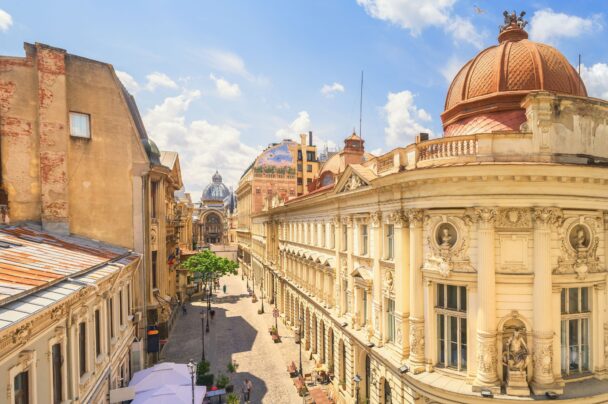
In this course, Bucharest’s history, stories, and urban landscape will be used as an open-air classroom.
It will be shown that the use of local heritage and urban memory can serve as an effective and engaging educational resource, responding to the growing need for place-based learning approaches felt in the field of education.
Through guided urban exploration, gamified activities, and reflective group workshops, participants will learn how to design educational activities based on cultural memory.
Promoting an experiential and student-centered approach that combines storytelling, reflection, and active students’ participation, participants will develop the skills needed to integrate city visits and urban exploration into daily teaching practice.
So, the activities that will be proposed during the week will not focus solely on cultural content. Participants will learn how to design walking tours, treasure hunts, and storytelling tips that can support critical observation, dialogue, and interdisciplinary learning.
By working with local heritage, the programme intends to connect experiential learning with practical classroom application, making sure that each site visit will then be followed by a collective structure reflection and activity design.
Participants will analyze how social spaces reflect social change and identity, getting to understand how to promote democratic values such as respect, tolerance, and a sense of belonging to a community.
They will also explore how to properly address delicate topics like heritage preservation and public representation, reflecting on the best ways to adapt them to different age groups and subjects.
By the end, participants will be able to integrate local heritage into lessons and interactive learning activities for their students.
They will have learned to use cities as stimulating learning spaces, having acquired concrete tools and activity models to transform everyday environments into structured and engaging learning experiences.
What is included
Learning outcomes
The course will help participants to:
- Integrate urban heritage into lessons and activities;
- Design interactive experiences such as walking tours and treasure hunts with clear educational objectives;
- Use storytelling, folklore, and public memory as tools for critical reflection;
- Foster students’ observation, dialogue, and critical thinking through place-based learning;
- Adapt urban exploration activities to different subjects and age groups;
- Reflect on how local heritage can strengthen students’ sense of belonging and community awareness.
Tentative schedule
Day 1 – Introduction to the course and place-based learning
- Introduction to the course and the Academy;
- Introduction to the host city and the week’s cultural activities;
- Icebreaker activities;
- Presentations of the participants’ schools and institutions;
- Identification of the participants’ expectations, needs, and goals for the course;
- Introduction to Bucharest’s cultural heritage;
- Methodology: how to use the city as a learning environment.
Day 2 – Exploring urban heritage: learning from the city center
- Guided walking tour focused on the 19th-century Bucharest “Little Paris” period and its architectural heritage;
- Analysis of urban contrasts: differences between restored heritage buildings and those in visible decay, encouraging critical observation and discussion about preservation, protection, and the social value of heritage (focus on the communist-era heritage);
- Discussion on preservation, public memory, and the social value of heritage;
- Understanding the layered history of the city, from the 19th century to the communist period;
- Developing skills in critical observation, interpretation, and reflection in urban environments;
- Exploring the social and educational value of cultural heritage for local communities;
- Gaining practical experience in using the city as a learning space;
- Learning how to create a culturally guided tour.
Day 3 – Exploring the city through gamification: treasure hunt learning
Village Museum (Muzeul Satului): Learning through Treasure Hunts
- Guided treasure hunt at the Village Museum (Muzeul Satului), designed to encourage observation, inquiry, teamwork, and critical thinking in an open-air heritage setting;
- Workshop: design and create a treasure hunt scenario within the Village Museum, focusing on educational objectives, inclusion, and engagement;
- Analysis of how gamification supports engagement and inclusion.
Design Lab
- Group work: creating treasure hunt scenarios with defined learning outcomes;
- Aligning game mechanics with educational objectives;
- Reflection on transferability to participants’ own cities and contexts.
Day 4 – Street art as a learning tool
- Street art and its role in the learning process: the city as an open-air gallery;
- Statues, murals, and various forms of street art, discovering techniques, artistic messages, and the social and cultural themes they address;
- Discussion on how public art reflects identity, protest, and cultural change.
Workshop
- Translating urban art into classroom activities;
- Designing reflective and age-appropriate learning tasks;
- Addressing sensitive topics through visual and urban literacy.
Day 5 – From experience to practice: designing learning activities
- Reflection, synthesis, and practical application of the learning experiences gained throughout the week;
- Brainstorming session on how heritage sites and urban spaces can be integrated into education, and on the types of learning activities that can be developed using cultural heritage;
- Development of final projects: walking tours, gamified experiences, interdisciplinary activities;
- Peer feedback and refinement;
- Traditional lunch together at a local restaurant or market, followed by a discussion about how gastronomy can be included in the educational process;
- Course evaluation: round-up of acquired competencies, feedback, and discussion;
- Awarding of the course Certificate of Attendance.
Day 6 – Structured cultural activities
- Structured cultural activity(ies) according to the hosting location;
- Learning journal: individual written reflection on the course experience;
- Course reflection: self-reflection and review of course materials and resources.
All entrance fees, guided visits, and workshops included in the programme are covered by the course fee.
These activities are exclusively reserved for enrolled participants.
Accompanying persons may not participate, even upon payment of an additional fee.
Download or share
Add to favouritesGet weekly recaps on confirmed sessions!

