Targeted to Intermediate English (B1+) speakers.Read more
This is the standard requirement for most courses. Participants at this level can participate actively in discussions and manage everyday and professional situations. If they are unsure about their English level, they can test it here or explore our courses facilitated in Basic English.
Pre-Primary Teachers.Read more
The listed audiences are those for whom the course is especially recommended, but courses are not exclusive to them and are open to everyone. In fact, most of our workshops are built around the collective sharing of participants’ experiences and having a variety of profiles enriches the learning process and is highly encouraged!
Description
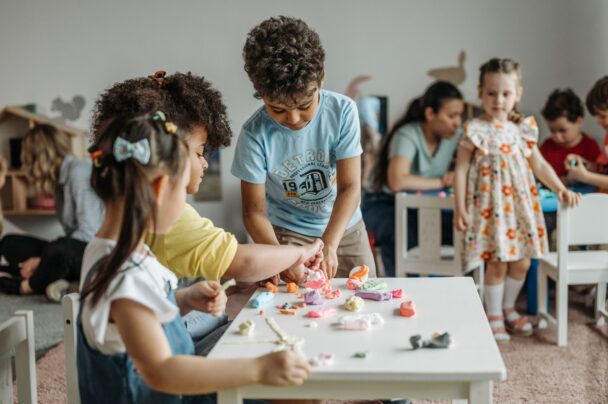
Play is one of the most natural and powerful ways children learn.
According to Fred Donaldson, it allows children to re-develop the universal skills they are born with while fostering creativity and imagination.
Through movement, imagination, exploration, and interaction, children develop not only cognitive skills, but also confidence, communication, creativity, and emotional awareness.
A playful learning approach boosts joy, intelligence, health, and self-esteem — without diminishing the self-esteem of others — and helps children build a fundamental trust in their world.
Yet, despite its many benefits, teachers often struggle with how to incorporate it into our schoolwork and how to make use of its positive aspects.
In many classrooms, in fact, playful learning is gradually replaced by more structured, worksheet-based approaches, even in the early years of education.
This course explores how play-based learning can support children’s holistic development and create more motivating and inclusive learning environments in early childhood and primary education.
By blending meaningful learning with activities children really enjoy, students become motivated, and learning reaches its full potential.
And last but not least, teachers also become more motivated by seeing students’ success.
Participants will discover how different types of play support cognitive, social, emotional, and physical development, while also exploring how Howard Gardner’s Multiple Intelligences theory can help teachers recognize and respond to children’s diverse strengths and ways of learning.
Throughout the week, participants will experience a wide variety of practical play-based activities (such as storytelling, movement games, music and rhythm, outdoor exploration, role-play, collaborative challenges, and sensory experiences) connected to different forms of intelligence and developmental areas.
Participants will also explore key ideas from educational thinkers such as Piaget, Vygotsky, and Fred Donaldson while also developing concrete classroom strategies that can be adapted to different ages and learning contexts.
By the end of the training, participants will be able to integrate a variety of play-based activities into their lesson plans and create an effective, tailor-made learning environment in their classrooms.
They will also feel more confident in designing learning experiences that recognise children’s different intelligences, strengths and ways of engaging with the world.
What is included
Learning outcomes
The course will help participants to:
- Understand key play-based learning theories (Piaget, Vygotsky, Donaldson) and their implications for early education;
- Explore Multiple Intelligences in the context of play-based learning;
- Create lesson plans and activities that are developmentally appropriate and interesting;
- Promote inclusive, learner-centered environments that support social, emotional, cognitive, and physical development;
- Recognize and foster diverse intelligences in every student;
- Create inclusive learning environments that support diverse learners;
- Design age-appropriate, practical, and interesting activities.
Tentative schedule
Day 1 – Introduction to the course
- Introduction to the course and the Academy;
- Introduction to the host city and the week’s cultural activities;
- Icebreaker activities;
- Presentations of the participants’ schools and institutions.
Foundations: Play and Learning
- Introduction to play-based learning theories;
- Play deprivation, its impact on children’s development, and some solutions;
- Reflection activity: “My play journey as a learner and teacher”.
Day 2 – Play and child development and multiple intelligences theory
- Creating playful and engaging learning environments;
- Understanding how play supports children’s holistic development;
- The connection between play, learning, and cognitive growth;
- Introduction to Multiple Intelligences theory;
- Experiencing play-based activities for:
- Logical–mathematical intelligence (puzzles, sequencing games, problem-solving tasks);
- Group reflection: How do these activities support learning in young children?
Day 3 – Creative intelligences & social play
- Play-based activities for:
- Linguistic intelligence (storytelling, rhymes, dramatic play);
- Bodily–kinaesthetic intelligence (movement games, role-play, dance);
- Musical intelligence (song, rhythm games, instrument play);
- Interpersonal intelligence (cooperative games, group challenges, peer problem-solving).
- Discussion: Social and emotional benefits of play in early education;
- Reflection on classroom adaptation: How to structure active and collaborative play.
Day 4 – Self, nature and meaning in play
- Outdoor play-based activities for:
- Intrapersonal intelligence (reflection games, emotion recognition);
- Naturalist intelligence (outdoor exploration, sensory nature play, plant/animal observation);
- Spatial intelligence (construction play, drawing, mapping activities).
- Existential intelligence (story circles, big questions through guided play);
- Workshop: Overcoming challenges in creating inclusive and developmentally appropriate play-based learning environments;
- Reflection and discussion: Linking play, curiosity, and holistic development.
Day 5 – From theory to practice
- Designing play-based lesson plans integrating multiple intelligences for early childhood and primary classrooms;
- Micro-teaching and role-play of created activities;
- Peer feedback, reflection, and sharing best practices;
- Take-home toolkit: lesson plans, activity ideas, and assessment strategies;
- Final reflection: “How I will bring play into my classroom every day”;
- Course evaluation: round-up of acquired competencies, feedback, and discussions;
- Awarding of the course Certificate of Attendance.
Day 6 – Structured cultural activities
- Structured cultural activity(ies) according to the hosting location;
- Learning journal: individual written reflection on the course experience;
- Course reflection: self-reflection and review of course materials and resources.
Download or share
Add to favouritesGet weekly recaps on confirmed sessions!